A command center that
your team will actually use.
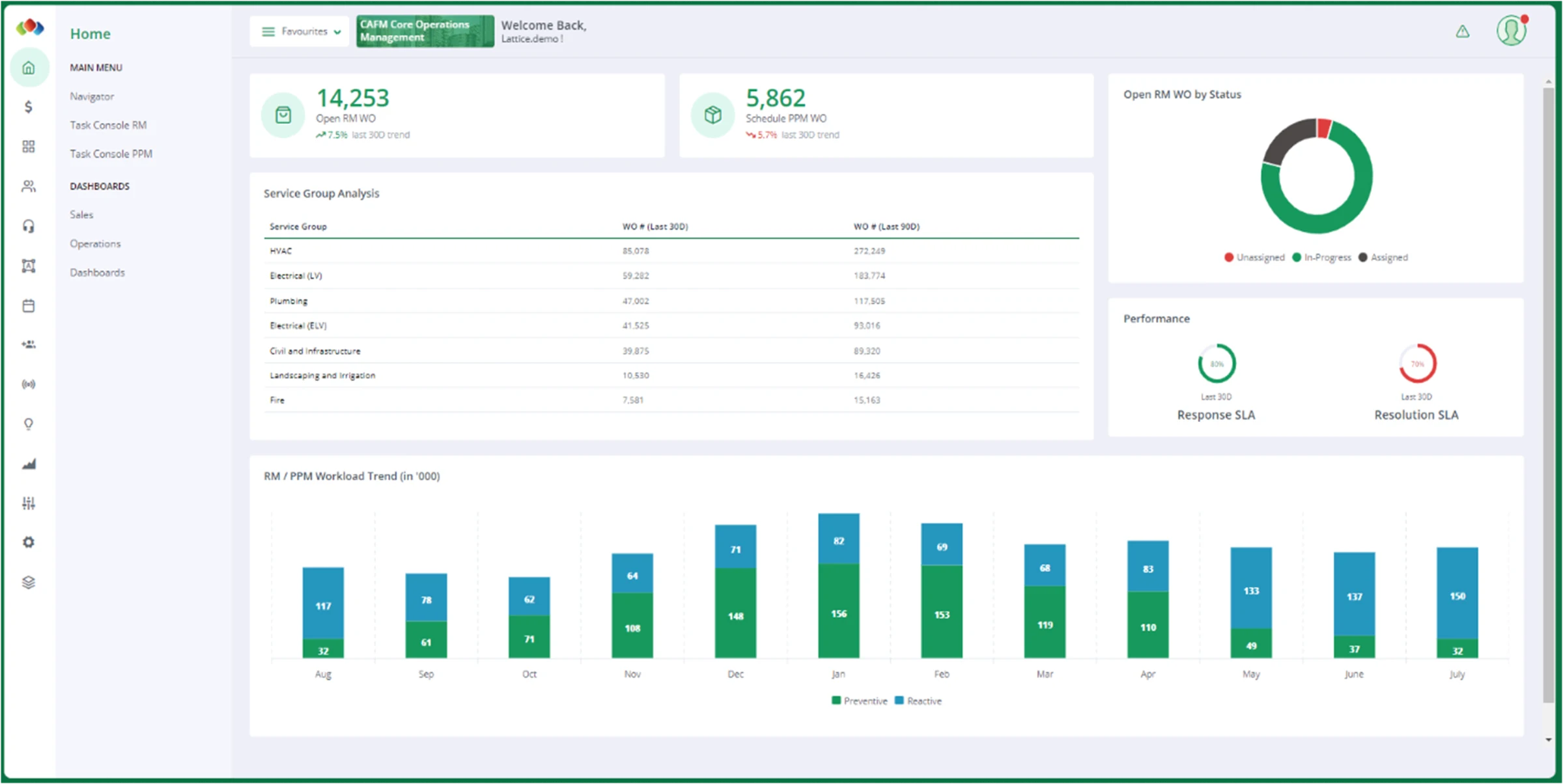
We obsess over the details so your operations teams don't have to fight their tools. Clean interfaces, fast workflows, zero training headaches.
Trusted across leading software marketplaces


A command center that your team will actually use.
Enterprise CAFM built in the region, with deep understanding of local regulations, operational realities, and business culture — including compliance-ready maintenance schedules, records, and reporting aligned with RERA, DEWA, Dubai Civil Defence, and ISO requirements.
Everything you need to run
your facilities — on one platform.
Helpdesk & Work Orders
Assign, track, and close work orders through a streamlined process. AI-powered prioritization ensures critical issues never wait.
Reports & Live Dashboards
Auto-generated reports and live dashboards for trends, SLA metrics, and actionable insights across every property.
Asset Lifecycle Management
Manage the complete lifecycle of every asset with 360-degree information, from install to decommission.
Vendor & SLA Management
Manage contractor details and track their performance against set SLA and KPI targets in real time.
Scheduled Maintenance
Auto-schedule maintenance per industry standards and compliances. Reduce unplanned downtime by up to 40%.
Energy & Inventory
Monitor energy consumption across contracts and manage stocks from anywhere for hassle-free operations.
Key terms, explained
Browse the FM glossaryA CAFM system is the software platform an FM operation runs on: a set of connected modules built around a shared asset register, used by managers through a web application and by technicians on mobile. Viewed as a system, it is a database of buildings and equipment, a workflow engine that turns requests and schedules into jobs, and a reporting layer that shows whether the work met the contract.
A work order is the instruction to carry out a specific piece of work, and the record of what happened when it was carried out. In facility management it is the basic unit of everything — the asset it relates to, who raised it, who did it, how long it took, what it cost, and whether it met the service level agreed with the client.
PPM stands for Planned Preventive Maintenance. It is maintenance carried out on a schedule to keep equipment working, rather than in response to something breaking. A PPM schedule sets out what gets serviced, how often, by whom, and against which standard — and in most facility contracts it is the work the client is actually paying for.
Asset tagging is the practice of attaching a unique, scannable identifier to each piece of equipment so that its history, documentation and maintenance schedule can be retrieved on the spot. It is the groundwork for every other part of a CAFM or CMMS deployment — without reliable tags, the asset register is a guess.
An SLA (Service Level Agreement) in facility management is the part of an FM contract that defines how quickly and how well the service provider must respond to and resolve issues, usually by priority level, and what happens when it does not. It turns a general expectation such as prompt repairs into measurable targets that can be tracked job by job.
See what Reflexion
can do for you.
Trusted by leading property developers and FM companies across the GCC — including marquee owners like Emaar, Dubai Sports City, and Al Mouj. Tell us about your portfolio and we'll show you exactly how Reflexion fits your operations.